
Understanding the core differences
Selecting a harvesting machine versus a grapple cutter is about understanding what each tool does, how it’s designed, and where it belongs in the woods. Both assist with harvesting and processing crops or wood, but their function and construction distinguish them. Harvesters are for mature crops or timber harvesting. They have a bit of cutting, a bit of gathering, and a bit of processing all in one machine. Grapple cutters are primarily for cutting and securing, not for complete processing. They’re elegant in their simplicity and rugged. They frequently hook up with other machinery to transport or load the cut material.
Harvesters excel in large crop fields or forests where speed and scale are important. They are best suited for grain crops such as wheat, corn, and rice or for harvesting trees in forestry. The harvester’s multi-step job is ideal for tasks requiring a single machine to chop, strip, and separate all at once. Grapple cutters are more suitable for locations where you have to cut and grab simultaneously—imagine orchards, tree farms, or areas with mixed brush. The reason for this dichotomy is that these tools are best suited for tasks that require a firm grasp and a precise slice, not the complete processing muscle of a harvester.
- Harvesters: These machines drive through rows or stands and use complex heads that both cut and process. For crops, the header slices and feeds plants into the combine, where they are threshed, separated and sorted by type, such as grain, straw, and chaff. The forest harvester head arms itself to the tree’s trunk, cuts it, de-limbs, and sections it in one movement. That’s all operated from a cab, with adjustments for speed, height, and cutting style. The operator can modify crop type or wood size settings, providing flexibility. It is a closed, heavy design with lots of moving parts, sensors, and even GPS at times for mapping fields.
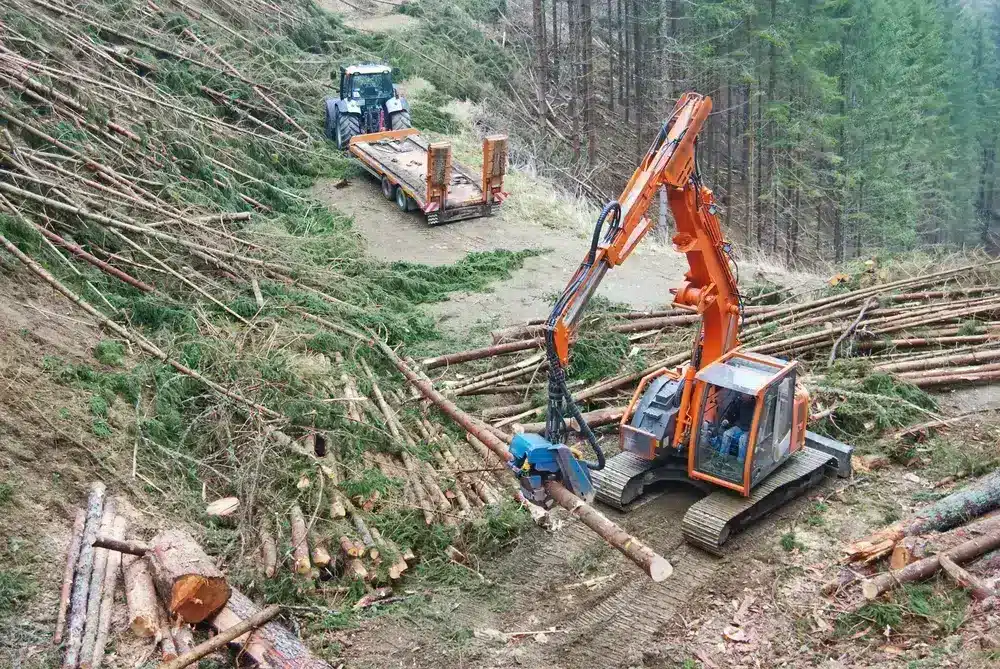
- Grapple Cutters: These are simpler. The central component is a pair of jaws or arms with a slicing blade. Jaws snatch the stem, and then a blade closes to slice it. Following the cut, the jaws maintain their grip, allowing you to maneuver or pile the piece without losing it. Grapple cutters generally affix to a tractor or loader. They require less tech and fewer moving parts than harvesters. Operators can exchange the grapple cutter between work, making it convenient for small or mixed crops, storm cleanup, or land clearing.
On a normal work day, harvesters sweep through fields or stands from end to end. They slash, mulch, and grade, sometimes dumping the finished goods in swaths or bins for collection. A single operator can cover a lot of ground fairly quickly, so they are essential for large-scale farming or logging. Grapple cutters cooperate with other equipment. Once it’s cut and grabbed, they then lift or pile it, all prepared for a forwarder, truck, or chipper. This linear workflow fits work where you have to relocate or pick as you go, such as orchard thinning or storm damage cleanup.
Evaluating task requirements and scenarios
Deciding between a harvester or a grapple cutter comes down to your farm’s specific needs, your crops, and your land. Every farm has different daily tasks, so it’s useful to examine the specifics for each configuration. A large-scale farm with expansive fields of either softwood or hardwood species will have demands that differ from a smaller mixed-use operation on hilly terrain. Understanding these distinctions can assist you in selecting the appropriate brew machine and maximizing your investment.
A harvester is ideal for either big time logging or plantation-style clear-cutting. It bucks, debarks, and crosscuts logs to specified lengths in a single pass. A grapple cutter, sometimes known as a feller buncher, grabs, cuts, and moves single trees, thus suiting it for more selective or careful logging or for work in dense, mixed forests.
Every one of these machines excels at certain farm tasks over others. Here are some common tasks and which machine usually gets the job done best:
- Large-scale clear-cutting: harvester
- Selective thinning or single tree removal: grapple cutter
- Working in dense, even-aged stands: harvester
- Jobs in mixed or uneven stands: grapple cutter
- Quick log processing at the stump: harvester
- Need to bunch and sort stems for later work: grapple cutter
- Slope or tough ground: grapple cutter (with tracked base)
- Flat, open ground: harvester
Terrain and crop density is a big factor! Harvesters excel on flat, open terrain where they can travel in straight lines and fell multiple trees simultaneously. Grapple cutters are superior on hills, uneven terrain, or in mixed woods where you might want to cut only select trees or operate in smaller clearings. For instance, if your land is packed with dense brush and tight places, a grapple cutter can maneuver in and out of these areas with ease. If you have flat land with large stands of a single tree species, a harvester will complete the task in no time.
To decide wisely, chart your priorities. These may include quickness, price, minimal turf impact, or maximum precision. A basic decision matrix can assist. Write down your requirements on one axis, such as quick, cheap, maintenance, slope-appropriate, thick woods appropriate, and skill required. Rate every machine for every need. Sum the points for a transparent glimpse into which implement suits your agricultural grind.
Comparing efficiency and productivity
Efficiency and productivity should be the deciding factors when comparing a harvester with a grapple cutter. Both machines can cut, manage, and transport wood. The difference is in how it affects the speed with which the job is completed, its cost, and the level of expertise required of the crew.
Harvesters operate by grasping, felling and delimbing trees in a single pass. On average, a harvester can handle 30 to 50 cubic meters per hour in softwood stands of moderate density. Some newer ones can hit even higher rates in flat, open terrain. Grapple cutters concentrate primarily on felling and bunching. They typically process 15 to 30 m³ per hour depending on tree size, terrain and operator skill. The table below shows these average rates to help with a quick side-by-side look:
| Machine Type | Average Work Rate (m³/hr) | Output Capacity (trees/hr) |
| Harvester | 30–50 | 60–100 |
| Grapple Cutter | 15–30 | 30–60 |
Real figures can fluctuate a great deal. For instance, in dense stands or flat terrain, harvesters can crush grapple cutters by a long shot. In rough, steep or mixed stands, grapple cutters may sometimes keep pace or even outperform because they can harvest in areas where a harvester might stall.
Downtime gnaws at productivity. Harvesters have intricate systems, including hydraulics, sensors, and computers, that require frequent checks. Minor problems, such as sensor faults or oil leaks, can cause abrupt halts. Most components are modular and simple to swap, but waiting for replacements can extend downtime to a few hours or even a day. Grapple cutters have fewer moving parts and simpler builds. When they break, repairs are usually quicker and less expensive. Because they do less per pass, they require more cycles to complete the same task, contributing to more wear in the long term and less chance of a giant, expensive failure.
Labor and skill requirements aren’t identical for the two. Harvesters require trained pilots who can manipulate sophisticated controls, interpret displays, and maintain periodic calibrations. It takes months to train them, and good operators are hard to come by in a lot of the world. Grapple cutters are more lenient. Operators need to know the fundamentals of heavy equipment, but the curve is less steep. In certain markets, this enables you to fill positions more quickly, but the compromise is that you may not achieve the same degree of accuracy or speed.
Assessing cost and investment
About: Calculating cost and investment is essential for people and businesses to get a realistic picture before deciding between a harvester or cutting grapple. This is about more than just considering the sticker price. It means considering all the dollars flowing in and out over time. A comprehensive cost-benefit check prevents surprises and supports more informed choices.
Upfront price is usually the first big piece of the cost puzzle. Harvesters, with their integrated high-tech features and automation, typically cost significantly more than cutting grapples. While a basic harvester can cost between 250,000 and 400,000 euros, a cutting grapple, depending on size and specs, often starts closer to 35,000 and 100,000 euros. This divide doesn’t seem like a thing for little companies or new buyers. Price tags don’t say everything.
Recurring costs are equally important. Harvesters are not only more fuel-hungry, but require more maintenance and have more expensive spare parts. Their intricate construction requires craftsmen, which can push up prices in regions where labor is expensive. Cutting grapples bolt onto base machines such as excavators, so their daily maintenance is easier and less expensive. They utilize fewer components, which lowers repair costs. If the base machine is ancient or not compatible with the grapple, upgrades could be required, bumping up the price.
Productivity gains and lifespan shape the actual ROI. Harvesters can fell logs more quickly, take care of sorting and reduce labor hours. On big projects, their fastness can compensate for that priciness in just a few years. For instance, a harvester working in an expansive forest can fell and process timber three times faster than a rudimentary grapple, resulting in more production and reduced on-site hours. In mixed or steep terrain, or where the wood is not uniform, a cutting grapple may perform equally and cost less to operate. Lifespan weighs in as well. Harvesters, with good care, can operate eight to 10 years, with parts wearing out sooner given heavy use. Cutting grapples, being simpler, tend to last longer and can be transferred between machines, which adds flexibility.
Budgeting for add-ons, parts and upgrades is frequently overlooked. Harvesters require additional custom tools such as specialized saws or high-end sensors, which increases costs. Spare parts are not only pricier but rarer in certain locations. Cutting grapples are simpler, but the correct jaws or blades for particular trees or work can accumulate. Both machines require a strategy for frequent upgrades, particularly as regulations and technology continue to evolve.